
Blog
12 March 2026
2D vs 3D Floor Plan Services: Which One Helps Sell Properties Faster?
There's a moment in every property search where photos stop being enough. A buyer has scrolled through the images, liked what they've seen, and now they're trying to figure out something more specific — does the layout actually work for how they live? Is the kitchen near the dining area? Are the bedrooms bunched together or spread out? How does the whole thing connect?
That's the question floor plans exist to answer. And for real estate professionals thinking about which format to use — 2D or 3D — the choice isn't always obvious. Both have genuine value. Both serve different purposes. And understanding where each one fits can make a real difference to how a listing performs.
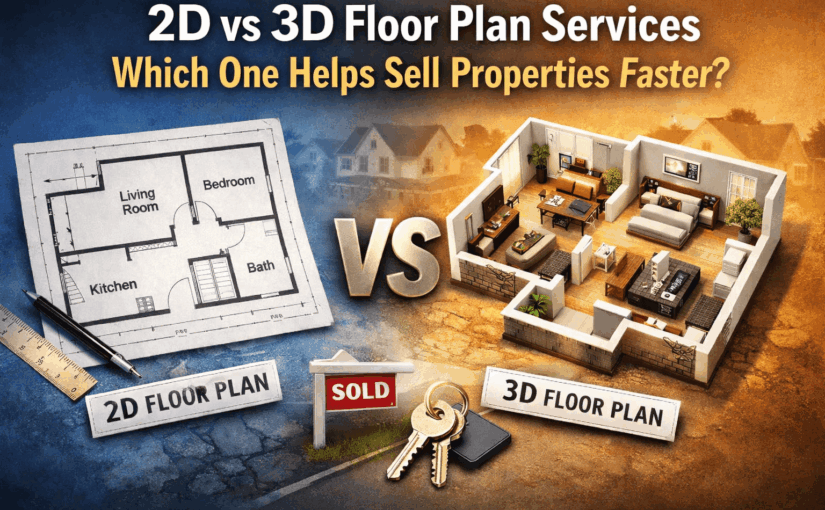
What 2D Floor Plans Actually Show
A 2D floor plan is a clean, top-down diagram of the entire property. No perspective, no furniture, no design flourishes — just a clear, accurate representation of how the space is laid out.
That simplicity is the point. A buyer can look at a 2D plan and within seconds understand the shape of the property, where the rooms sit in relation to each other, and how movement works through the home. It's practical information, delivered without asking the buyer to interpret anything.
Here's what you'll usually find in a 2D floor plan:
- Room names written out plainly — bedroom, kitchen, living room
- Where the walls, doors, and windows fall
- How you move through the home, from entry to each space
- Room sizing, either as actual measurements or scaled proportions
Agents and listing teams gravitate toward 2D plans for a simple reason: buyers can pick one up and understand it immediately. No design knowledge required, no time spent interpreting a render. The layout is just there, readable at a glance, on any screen, in any format.
What 3D Floor Plans Add to the Picture
A 3D floor plan takes the same spatial information and presents it with visual depth. Rather than a flat diagram, the buyer sees a rendered, angled view of the interior — often with furniture, realistic textures, and colour to simulate how the finished space might look.
The shift is meaningful. A 2D plan tells you how a property is arranged. A 3D plan shows you how it might feel to actually be in it.
What a well-produced 3D floor plan typically includes:
- Furniture and décor placed to scale within each room
- Flooring textures, wall colours, and material finishes
- A three-dimensional perspective that conveys spatial depth
- Visual context that helps buyers imagine the space in use
For properties that are vacant, unfinished, or still under construction, this kind of visual storytelling fills a gap that photos simply can't fill. There's nothing to photograph yet — but a 3D floor plan can show buyers exactly what they're committing to.
Why Floor Plans Matter So Much in the First Place
Here's the underlying issue: property photos, however good they are, only show fragments. A kitchen shot, a bedroom image, a view of the living area — each one is a piece of a puzzle that buyers are trying to assemble in their heads without all the information they need.
Some buyers are good at this. Others aren't. And the ones who find it difficult don't always reach out to ask — they just move on to the next listing.
Floor plans make that mental work unnecessary. Instead of guessing at the relationship between spaces, buyers can see it directly. That clarity tends to keep people engaged with a listing longer, generate more informed enquiries, and attract buyers who've already decided the layout suits them — rather than those who are still trying to work that out.
For agents and builders, the practical payoff is better quality leads. A buyer who contacts you after studying the floor plan is already further along in their thinking than one who's still piecing together the layout from photos.
The Real Differences Between the Two Formats How They Look
The visual difference is obvious, but it reflects a deeper difference in purpose. A 2D plan prioritises information — structure, proportions, relationships between spaces. A 3D plan prioritises imagination — helping buyers picture themselves living in the home.
Neither is inherently better. They're solving different problems for different buyer mindsets.
What They Communicate
A 2D floor plan answers the analytical questions: How big is this room? Where's the bathroom in relation to the main bedroom? Does the kitchen open into the living area or sit separately?
A 3D floor plan answers the emotional questions: Can I see myself here? Will my furniture fit and look right? Does this space feel the way I want it to feel?
Some buyers lead with analysis. Others lead with feeling. Many shift between the two as their search progresses — which is exactly why both formats have a place.
How Each Format Fits Different Marketing Situations
On platforms where buyers are actively comparing properties — scrolling through MLS results, filtering by bedroom count, bouncing between listings — 2D plans fit naturally. They're quick to scan, require no visual interpretation, and sit cleanly alongside listing photos without demanding attention they haven't earned yet.
3D plans suit a different kind of moment. When a buyer is deeper into their search, spending real time with a specific property, a rendered layout adds something a diagram can't — a sense of what it might actually feel like to be in the space. That's why 3D plans tend to show up in developer showrooms, premium brochures, and off-plan campaign materials rather than standard portal listings.
Where 2D Plans Remain the Practical Default
The 3D format looks impressive, but 2D floor plan services have held their ground as the most widely used option in everyday real estate marketing — and the reasons are fairly practical.
MLS and property portals — Speed and clarity matter here. Buyers are in comparison mode, not browsing mode. A clean 2D layout gives them the information they need without slowing them down or asking them to engage with a visual that requires more processing time.
Apartment and multi-unit buildings — When a development has several different unit configurations, buyers need to compare layouts side by side. A consistent 2D format makes that comparison quick and easy.
High-volume listing pipelines — For agencies pushing out a large number of listings regularly, 2D plans make operational sense. They're quicker to produce, easier to standardise, and slot into any platform or format without needing adjustment for each one.
Detail-focused buyers — Some purchasers — particularly investors, developers, or experienced buyers — want precise layout information above everything else. A 2D plan gives them exactly that without visual distractions getting in the way.
Where 3D Floor Plans Earn Their Place
3D floor plan services come into their own when the visual experience of the property needs to carry some of the marketing weight.
New build and off-plan projects — When a property isn't finished yet, there's nothing to photograph. A 3D floor plan steps in and shows buyers what they're committing to — with enough visual realism to make that feel tangible rather than abstract.
Vacant and empty properties — Empty rooms photograph badly. They feel cold and hard to read at scale. A 3D floor plan sidesteps this entirely by showing the space as it could look, furnished and lived in, without the cost of physical staging.
Luxury and premium listings — Buyers at the upper end of the market bring higher expectations to every element of the marketing material, including the floor plan. A rendered 3D layout communicates that the property has been presented with genuine care — which, at that price point, buyers notice and respond to.
Developer sales campaigns — Builders and developers regularly use 3D floor plans in their pre-launch marketing, showroom displays, and investor presentations — anywhere that visual impact needs to do as much work as factual information.
How Floor Plans Fit Into a Wider Marketing Workflow
Floor plans work best as part of a complete marketing package — not in isolation. Most professional property marketing now brings several elements together:
- Professionally shot property photography
- Post-production editing for colour, lighting, and sky replacement
- Background removal and image enhancement for a clean, consistent look
- 2D floor plans for layout clarity
- 3D floor plans where visual storytelling is needed
Real estate photographers often handle the shoot and then work with photo editing specialists and floor plan teams to deliver everything as one package. That kind of workflow means clients receive complete marketing assets — images and layouts together — without any single person carrying the entire production load.
During busy periods, when listing volumes spike and deadlines tighten, having that kind of reliable support structure in place makes the difference between a smooth pipeline and a stressful one.
So Which Format Actually Helps Sell Properties Faster?
Framing it as a head-to-head competition misses what's actually going on. 2D and 3D floor plans aren't rivals — they complement each other. They serve different buyer mindsets, suit different marketing contexts, and do their best work at different stages of the decision-making process.
A listing that includes both gives buyers everything they need: the layout clarity of a 2D diagram and the visual engagement of a 3D render. Combined with strong photography and professional photo editing, that's a package that works considerably harder than any single element could on its own.
If budget or timeline means choosing one, a 2D plan is almost always the right starting point — versatile, universally readable, and compatible with every platform. Layer in a 3D plan when the property type or campaign calls for something more visually immersive.
Why Outsourcing Floor Plan Production Makes Sense
Building accurate, well-designed floor plans requires specialist software, design knowledge, and focused time that most real estate teams genuinely don't have spare. Handling it in-house typically creates a bottleneck — delivery slows, quality varies, and the people who should be focused on marketing end up doing production work instead.
Outsourcing to a dedicated floor plan service removes that friction entirely. Measurements or sketches go in, and polished, marketing-ready layouts come back on a reliable schedule. For photographers or agencies managing a consistent volume of listings, that predictability has real operational value.
The broader benefits are straightforward:
- Turnaround times that hold up even when listing volumes spike
- Consistent output quality rather than results that vary depending on who's working that day
- Professional layouts that integrate cleanly with photography and branding assets
- The ability to scale capacity up or down without any internal hiring pressure
Final Thoughts
Buyers need two things from a floor plan: to understand the space, and to imagine themselves in it. A 2D plan handles the first. A 3D plan handles the second. Used together, they make a listing more informative, more engaging, and more likely to generate the kind of serious enquiry that actually moves a sale forward.
For builders, agents, and developers who want their listings to work harder — and attract better-qualified buyers in the process — investing in professional floor plan services is one of the more straightforward decisions in the marketing mix. The format question matters less than the quality and consistency of what you produce.
FAQs
What's the main practical difference between 2D and 3D floor plans?
A 2D plan is a flat diagram — straightforward, structural, focused on layout and spatial relationships. A 3D plan adds visual dimension: furniture, finishes, depth, perspective. One tells buyers how the property is arranged; the other helps them picture what it's actually like to move through it.
Are 2D floor plans still worth using when 3D options exist?
Without question. The two formats aren't competing — they're doing different jobs. 2D plans suit the practical, information-led side of a property search: quick to read, compatible with every platform, instantly understood by anyone. Most MLS listings use them as standard, and that's unlikely to change anytime soon.
Do 3D floor plans actually influence buyer decisions?
For the right property and the right buyer, yes. When someone is looking at a vacant home or an off-plan development and struggling to mentally furnish the space, a well-produced 3D plan can genuinely shift how they feel about it. Whether that accelerates a sale depends on the individual — but the engagement it creates is real and measurable.
Is it worth including both formats in a single listing?
For premium properties, new builds, or homes where the layout is a strong selling point, using both makes sense. The 2D plan handles the analytical side of how buyers evaluate a space; the 3D plan handles the emotional side. Together they cover more ground than either format does working alone.
Can photographers offer floor plan services alongside their photography?
Many do, through partnerships with specialist editing and floor plan providers. This lets them deliver a complete marketing package — photography, post-production editing, and floor plans — without managing all of the production work themselves, which is particularly useful during high-volume periods.